


ECC Tutorial and ECC Toolkit
On this page you will find two standalone, complementary resources on elliptic-curve cryptography (ECC) accompanying Chapter 8 of the CrypTool Book:
- ECC Tutorial — an interactive web application with all the chapter's examples as live-executable SageMath and JavaScript programs.
- ECC Toolkit — a collection of 17 standalone SageMath scripts to run directly in a terminal.
About the ECC Tutorial
The ECC Tutorial is a self-contained, interactive web application on elliptic-curve cryptography (ECC).
All 7 chapters and 29 figures cover the same range of topics as Chapter 8 of the CTB — including the topics added since the original 2011 version, such as Curve25519/Ed25519, Lenstra's ECM factorization, and PQXDH as an example of post-quantum hybrid key agreement. The difference isn't in the material, but in the form: Instead of individual, fixed worked examples in book form, the Tutorial presents every topic as a fully editable, live-computed figure across seven chapters that build on one another — from the fundamentals up to the protocols which use ECC.
Computation is done either by your own local SageMath install or directly as JavaScript in the browser (with no server call at all). No account, no cloud service — no SageMath output ever leaves your machine.
Download ECC TutorialInstallation instructions
- Extract the ZIP archive "ecc-tutorial.zip" to a directory of your choice.
- Open a terminal (command-line window) in that directory.
- Start the server in the terminal:
python3 server.py - Open the specified address in your browser:
http://localhost:8765/
See the file "readme-usage-webapp.txt" in the zip archive.
Ensure that the section "Instructions and SageMath Version" on the starting page confirms that a local SageMath installation was found.
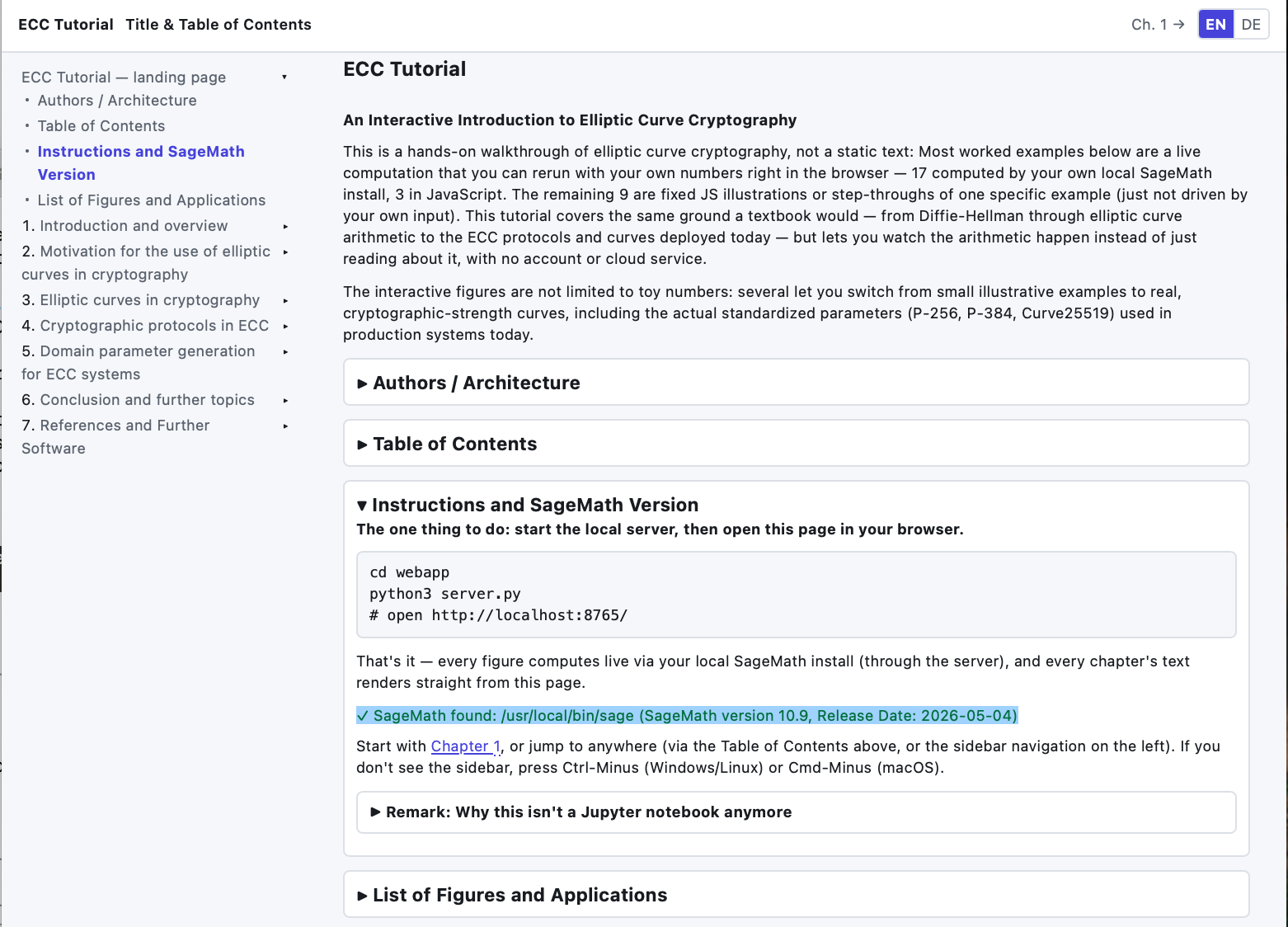
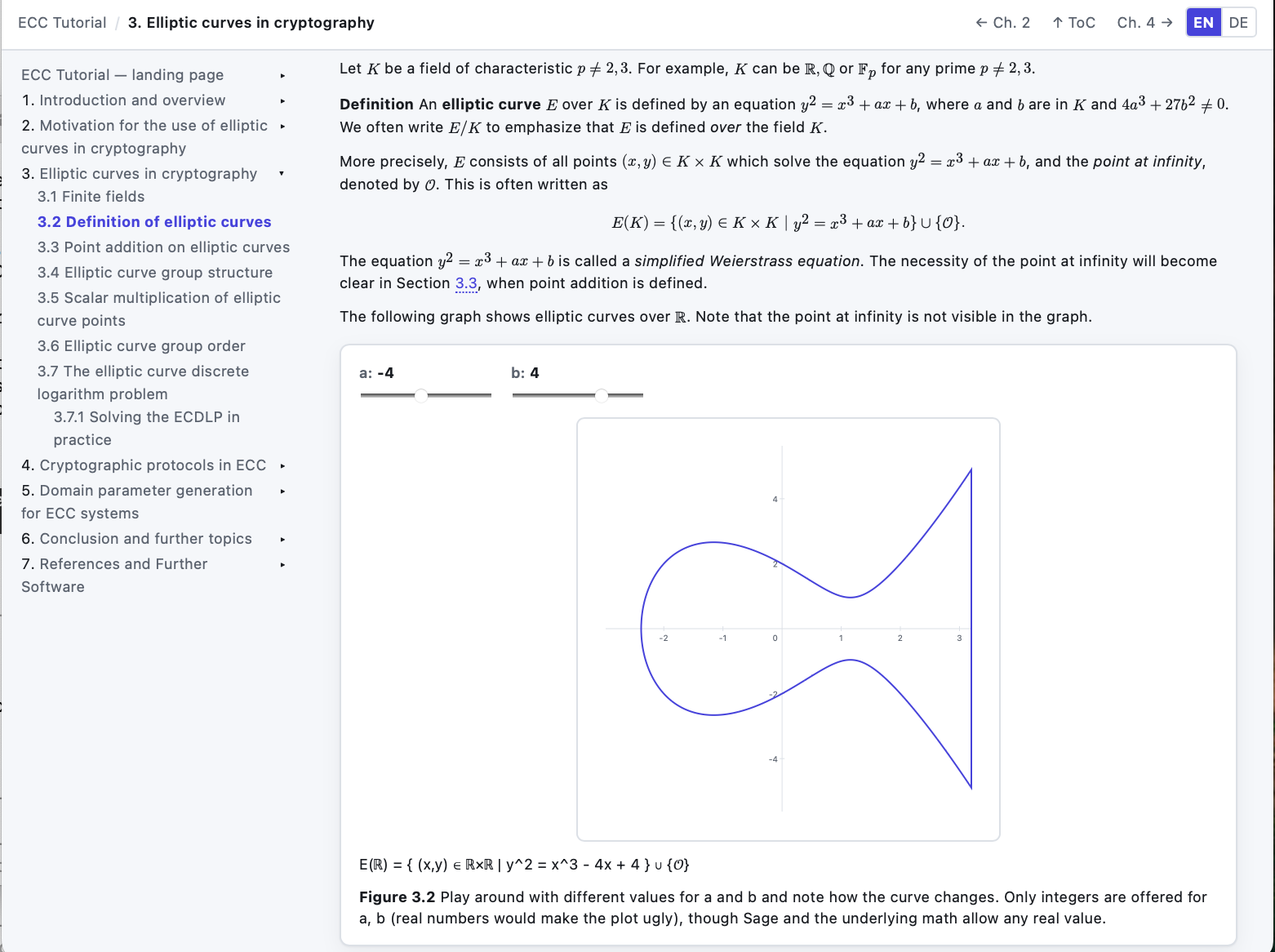
Then read Chapter 1, or navigate to any section using the table of contents (ToC) on the home page. Each figure has its own controls (sliders, numeric input fields, buttons). When you adjust them, the result is calculated immediately.
Content of the ECC Tutorial
The tutorial comprises 29 interactive figures, sorted by chapter: 17 are computed by your local SageMath installation SageMath, and 12 run directly in the browser JavaScript.
Chapter 1 — Introduction and overview
- 1.1 The document's chapter structure JavaScript
Chapter 2 — Motivation for the use of elliptic curves in cryptography
- 2.1 Diffie-Hellman key exchange (1) JavaScript
- 2.2 Number of possible keys SageMath
- 2.3 Calculation of primitive roots SageMath
- 2.4 Diffie-Hellman key exchange (2) SageMath
- 2.5 Diffie-Hellman key exchange (3) SageMath
- 2.6 DLP brute-force search SageMath
- 2.7 Running time comparison of exponential, sub-exponential and polynomial-time algorithms JavaScript
Chapter 3 — Elliptic curves in cryptography
- 3.1 Elliptic curves defined by JavaScript
- 3.2 Elliptic curves over the real numbers SageMath
- 3.3 Elliptic curves over finite fields SageMath
- 3.4 Point addition JavaScript
- 3.5 Point doubling JavaScript
- 3.6 Point at infinity JavaScript
- 3.7 Point addition for elliptic curves over the rational numbers SageMath
- 3.8 Point addition for elliptic curves over finite fields SageMath
- 3.9 Double-and-add algorithm JavaScript
- 3.10 Comparison of the three methods of scalar multiplication JavaScript
- 3.11 Solving the ECDLP: baby-step giant-step and Pollard's rho SageMath
Chapter 4 — Cryptographic protocols in ECC
- 4.1 Elliptic Curve Diffie-Hellman (ECDH) SageMath
- 4.2 Man-in-the-middle attack on unauthenticated ECDH, and authenticated ECDH SageMath
- 4.3 ECIES: hybrid public-key encryption SageMath
- 4.4 ECDSA: Signing and Verifying SageMath
- 4.5 EdDSA: deterministic signing on Edwards25519 JavaScript
Chapter 5 — Domain parameter generation for ECC systems
- 5.1 Standardized curve parameters SageMath
- 5.2 Twisted Edwards point addition (no exceptional cases) JavaScript
Chapter 6 — Conclusion and further topics
- 6.1 Recommended key lengths JavaScript
- 6.2 Factoring integers with elliptic curves (Lenstra's ECM) SageMath
- 6.3 PQXDH: post-quantum-extended key agreement SageMath
Chapter 7 — References and Further Software
No interactive programs.
The ECC Toolkit
The ECC Toolkit is a self-contained collection of 17 SageMath scripts on ECC. Each script is a single, self-contained example — fixed example values, printable text output instead of JSON, no server, no browser. Runnable directly via sage scriptname.py in a terminal, or via load("scriptname.py") in an interactive SageMath session, so every computed value stays available to keep experimenting with afterward. These SageMath programs are exactly the same ones used in the ECC Tutorial.
SageMath programs in the ECC Toolkit
17 standalone SageMath scripts, sorted by chapter:
Chapter 2 — Motivation for the use of elliptic curves in cryptography
fig2_2_dh_number_of_keys.py— how many distinct keys exist: the order of gfig2_3_primitive_root.py— finding a primitive root mod pfig2_4_dh_random_secrets.py— classic DH exchange, p/g fixed, secrets randomfig2_5_dh_chosen_secrets.py— the same exchange, every value chosen freelyfig2_6_dlp_brute_force.py— solving the DLP by brute force — and why it doesn't scale
Chapter 3 — Elliptic curves in cryptography
fig3_2_curve_over_reals.py— non-singularity check plus sample points, E overfig3_3_curve_over_finite_field.py— every point of E over , plusfig3_7_point_addition_rationals.py— point addition over , full λ/xR/yR formulasfig3_8_point_addition_finite_field.py— the same addition, over insteadfig3_11_solving_ecdlp.py— baby-step giant-step and Pollard's rho, cross-checked against each other
Chapter 4 — Cryptographic protocols in ECC
fig4_1_ecdh.py— ECDH on a real (toy-size or 256-bit) random curvefig4_2_mitm_and_authenticated_ecdh.py— MITM attack on unauthenticated ECDH, then the same attack caught by ECDSA-authenticated pointsfig4_3_ecies.py— ECIES hybrid encryption: ECDH + KDF + encrypt-then-MACfig4_4_ecdsa_and_nonce_reuse.py— ECDSA signing/verifying, then the nonce-reuse attack that recovers the private key
Chapter 5 — Domain parameter generation for ECC systems
fig5_1_standardized_curves.py— verifying the real, published parameters of P-256, P-384, Curve25519, and secp256k1
Chapter 6 — Conclusion and further topics
fig6_2_ecm_factorization.py— Lenstra's ECM: factoring integers with elliptic curvesfig6_3_pqxdh.py— PQXDH: Signal's post-quantum-extended X3DH key agreement
Not included in the toolkit are the ECC Tutorial's 12 JavaScript programs. They have no SageMath counterpart and run in the ECC Tutorial without any server/Sage call.